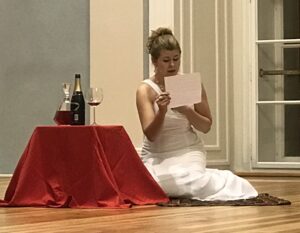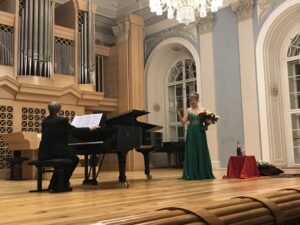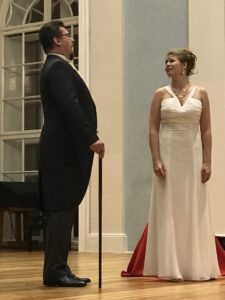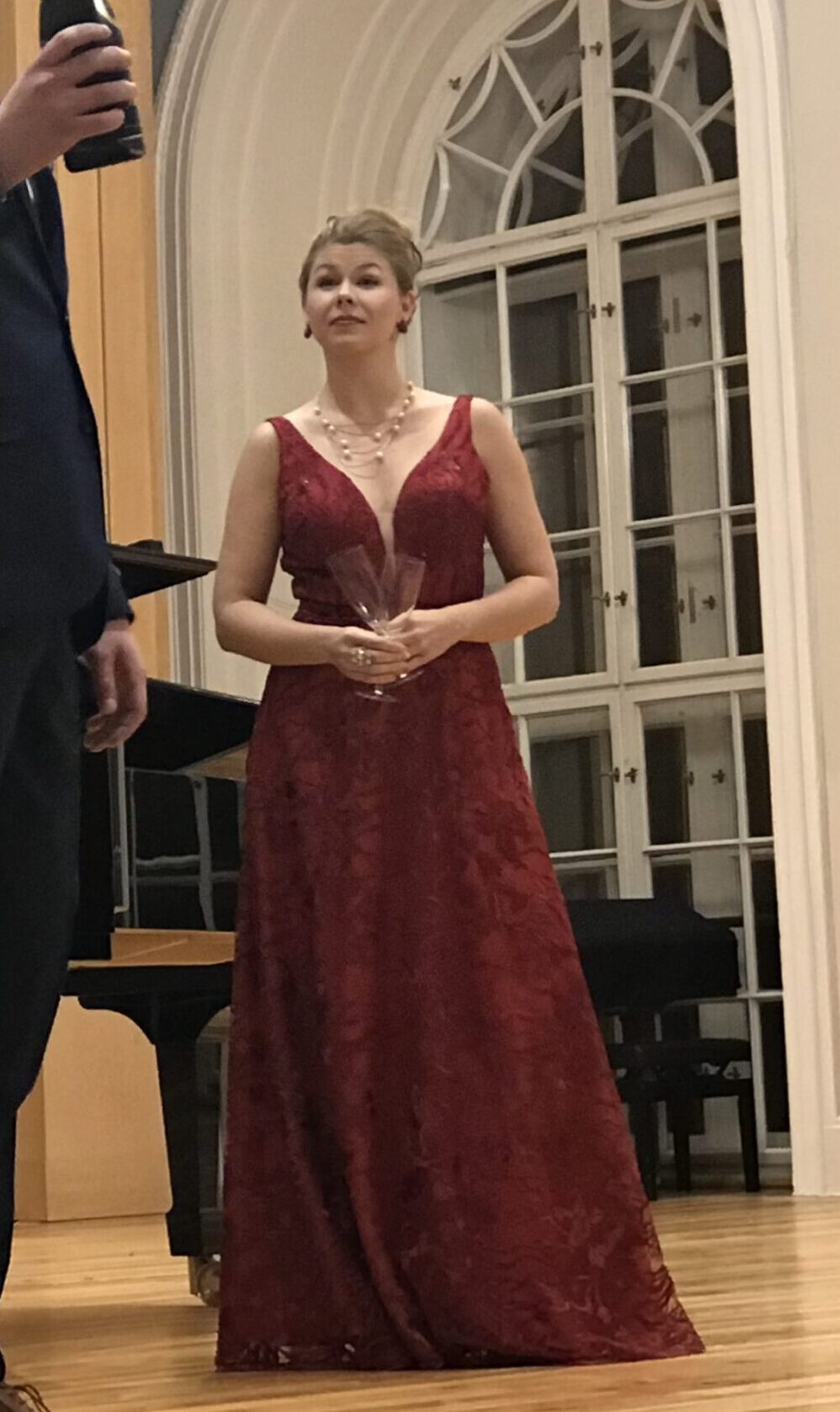
Even after 165 years since the creation of La traviata, the popular romantic opera by the Italian phenomenon Giuseppe Verdi, the character of the Parisian courtesan Violetta Valéry is still one of the most important and admired roles in the soprano repertoire. The young singer Lucie Kaňková chose this character as the topic of her doctoral studies at the Prague Academy of Performing Arts and presented a representative cross-section of the opera with her singing colleagues as part of her second doctoral concert. The clever dramaturgy of the evening brought contrasting examples from the works of some opera composers of the 20th century – Igor Stravinsky, Bohuslav Martinů and Leonard Bernstein.
For the theme of the opera La Traviata, Giuseppe Verdi, somewhat uncharacteristically for him at that time, turned to the novel The Lady of the Camellias by his contemporary Alexandre Dumas the Younger, written in 1848. Some of Verdi’s biographers attribute this fact to a certain personal identification of the composer in the novel with his own passionate relationship with the soprano Giuseppina Strepponi. The libretto was created by Verdi’s court librettist Francesco Maria Piave and the opera premiered in 1853. Regarding the Verdi theme and the concert itself, Lucie Kaňková says: “I like to put roles in broader contexts – this year’s concert in dramaturgy follows on from my first year as a doctoral student, when I composed the concert program from both Verdi’s arias and the works of his predecessors and contemporaries. This time, in addition to Violetta, I will present interesting arias by composers who successfully shaped opera after Giuseppe Verdi in the 20th century.”
This sympathetic approach, which has not been widely practiced by singers in the Czech regions, was also underlined by Lucie Kaňková with a precise performance – the concert opened with the popular Duet Libiamo, where promising tenor Daniel Matoušek introduced himself as Alfred. The duo created a pleasant, relaxed atmosphere with their performance and brought the entire Martinů Hall into the action. The second number of the evening was the performance of the suggestive aria È strano…Sempre libera, where Lucie Kaňková also showed a distinct ability to portray more passionate emotional positions. In the following duet, Lucie Kaňková invited another colleague, baritone Martin Bárta, to the stage. In their performance, the duet of Violetta and Germont was carried out in a suggestive spirit, with both singers letting the audience fully feel the emotional weight of this conversation. At the end of the first half of the concert, Lucie Kaňková showed the contradiction and hopelessness of Violetta’s life situation with a great and heartfelt performance of the aria Addio del passato, thus closing this exclusive section of the opera La traviata with dignity.
If in the first half of the concert Lucie Kaňková demonstrated her excellent dramatic potential in her portrayal of Violetta, in the second half, when performing arias by opera authors of the 20th century, she further upgraded her performance. From my subjective point of view, the interpretation of newer works is a really strong weapon for Lucie Kaňková and I am not afraid to write that she has already reached world level in this discipline. The well-known Russian musical innovator Igor Stravinsky completed his neoclassical-conceived opera The Rake’s Progress in 1951. He was inspired by a series of eight paintings by the English classicist painter William Hogarth. In Lucie Kaňková’s performance, Anna’s expressively difficult aria My father…I go to him was an extremely powerful listening experience, which further highlighted the contrast between the musical languages of Verdi and Stravinsky.
Lucie Kaňková put the absolute top on an already excellent evening with a fantastic performance of Ariadne’s aria Thésée, je respire from the workshop of the Czech modernist Bohuslav Martinů, whose one-act opera Ariadne was composed in 1958. The soprano really showed everything here and then some – there were musical moments that cannot be described in words, but remain in the memory. The final number of the evening, on the contrary, brought a pleasant relief, mediated by Cunégonde’s aria Glitter and Be Gay from Candide, a not very well-known operetta in our region, written in 1956 by the famous American composer and conductor Leonard Bernstein. Lucie Kaňková confirmed that she is also at home in comedic roles, so to speak, and thus gave a sympathetic finish to her excellent artistic performance.
The thunderous ovation in the Martinů Hall left no doubt that she would continue – with Edvard Grieg‘s romantic song Ich liebe Dich and Adéla’s aria Mein herr Marquis from Johann Strauss the Younger’s operetta Die Fledermaus, Lucie Kaňková crowned her undoubtedly extremely successful doctoral concert. Finally, it is fitting to add that pianist Stanislav Bogunia was an indomitable support to Lucie Kaňková during her recital, who visibly enjoyed the entire evening, together with the young opera singers, beautiful arias and a positively attuned audience.
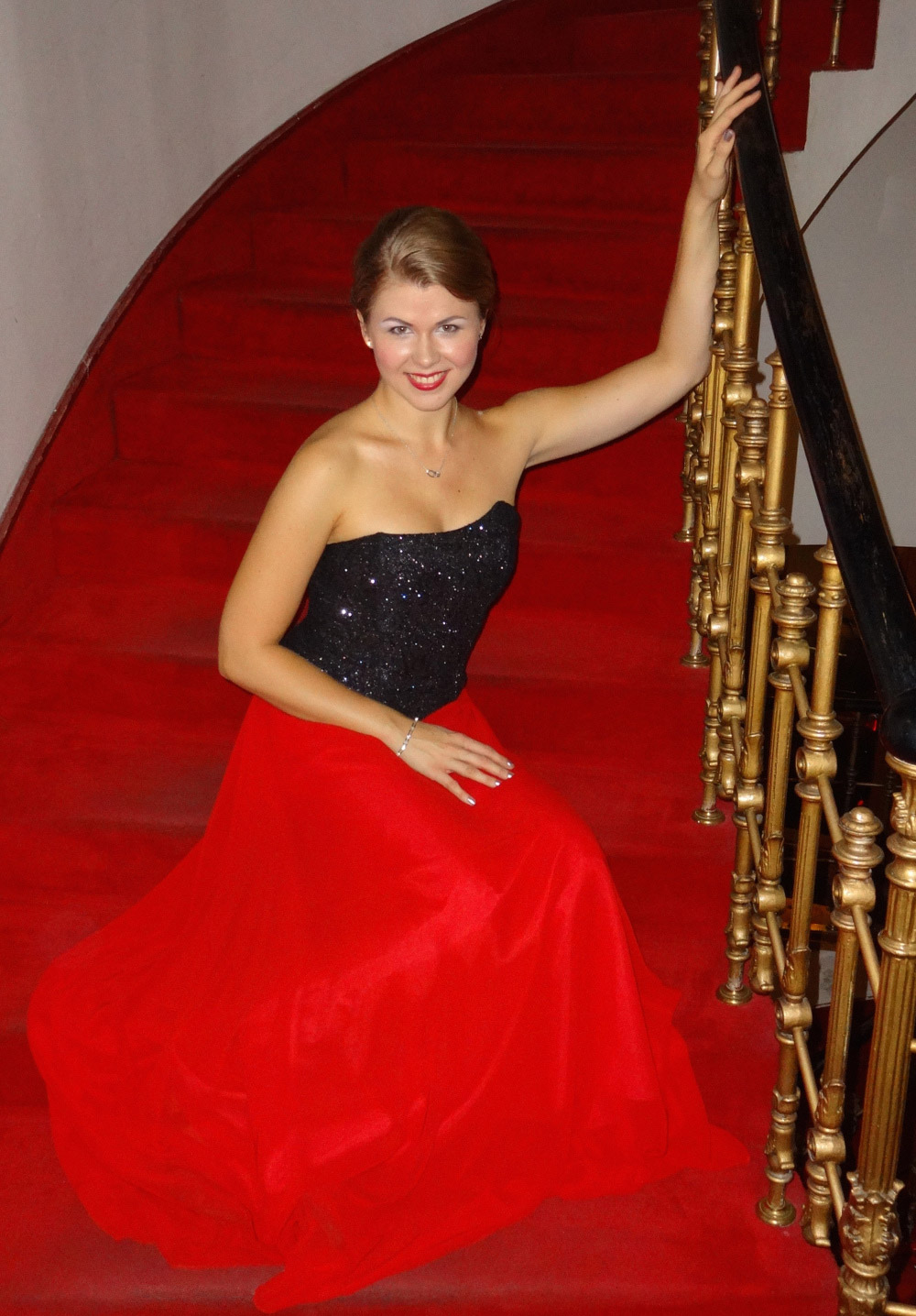
Lucie Kaňková is currently dedicated to developing all performative singing disciplines. “After winning 1st prize in the Antonín Dvořák Competition in 2016, many recital, concert and theatre opportunities opened up for me,” he adds. All that remains is to wish him much success and more such unique recitals as we had the opportunity to hear in the Martinů Hall!
Photo: Pavlína Kaňková
KlasikaPlus.cz 9.12.2019