When I sing, I feel great.
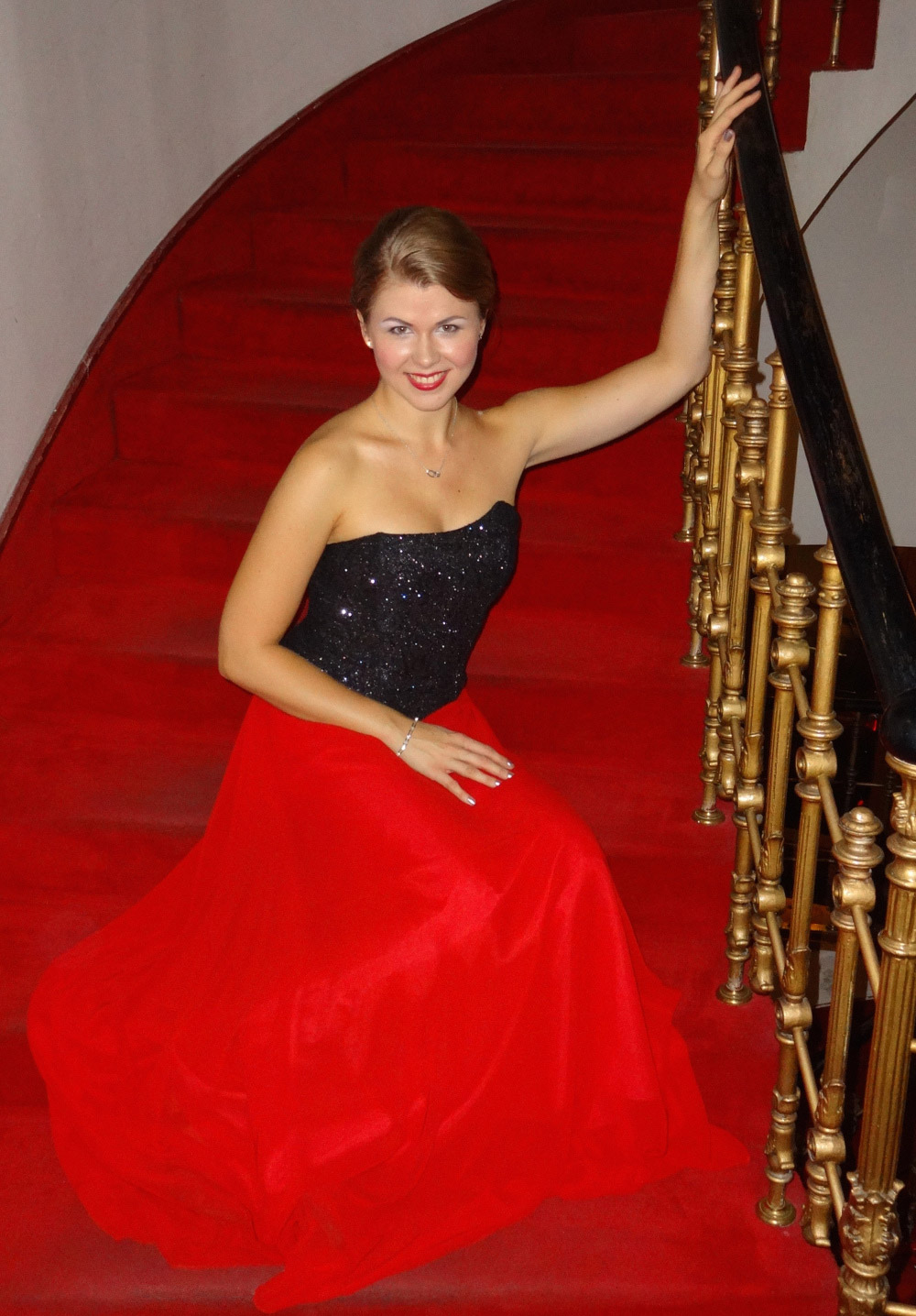
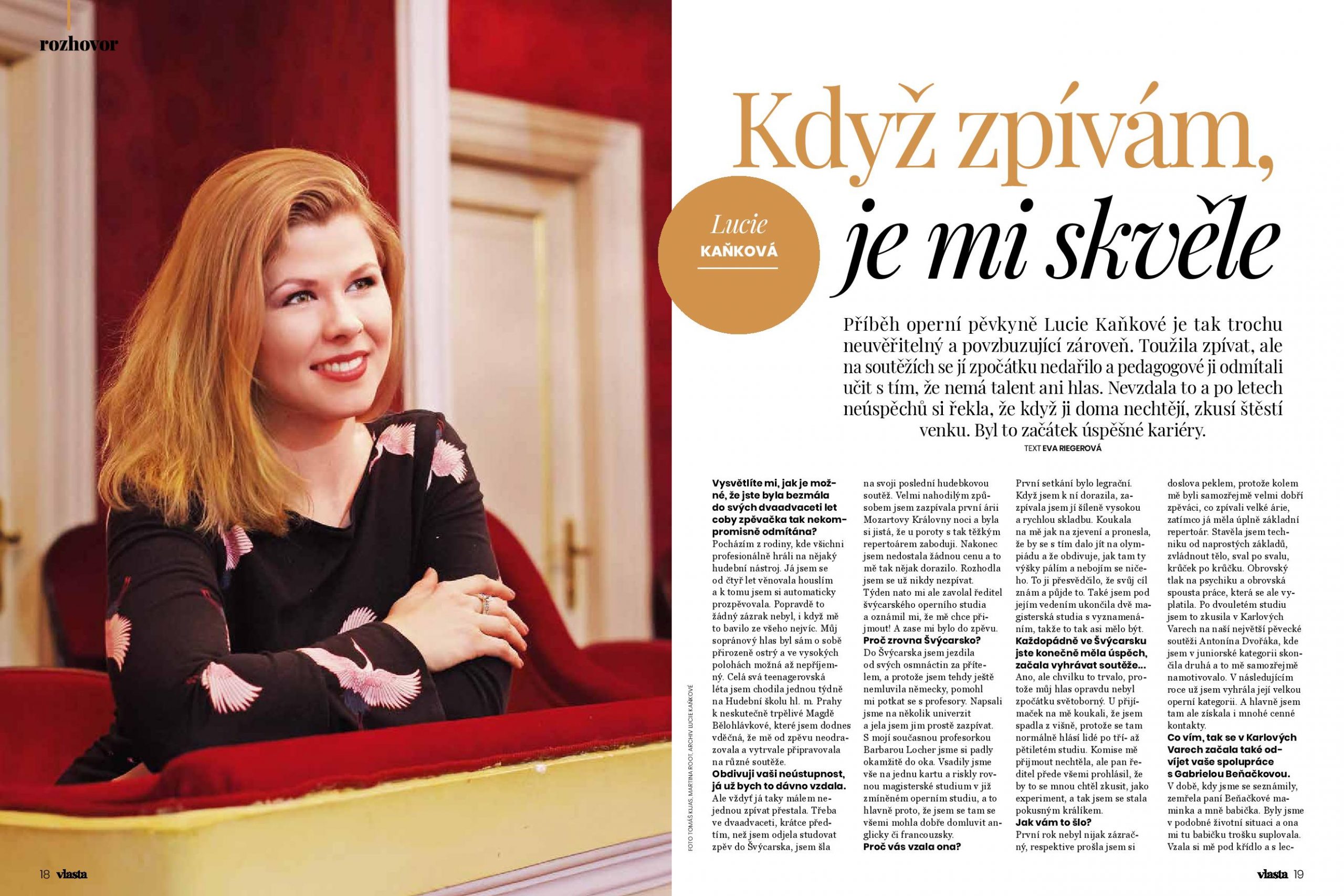
The story of opera singer Lucie Kaňková is both incredible and encouraging. She longed to sing, but she initially failed in competitions and teachers refused to teach her, saying that she had neither talent nor voice. She didn’t give up and after years of failures she decided that if they didn’t want her at home, she would try her luck outside. It was the beginning of a successful career.
Can you explain to me how it is possible that you were so unceremoniously rejected as a singer until the age of twenty-two?
I come from a family where everyone played a musical instrument professionally. I started playing the violin when I was four years old and I automatically sang along to it. It was no miracle, to be honest, even though I enjoyed it the most. My soprano voice was naturally sharp and perhaps even unpleasant in the high positions. Throughout my teenage years, I went to the Prague Music School once a week to the incredibly patient Magda Bělohlávková, to whom I am still grateful to this day for not discouraging me from singing and for persistently preparing me for various competitions.
I admire your intransigence, I would have given up long ago.
But I almost stopped singing once too. For example, at twenty-two, shortly before I left to study singing in Switzerland, I went to my last music competition. I sang the first aria from Mozart’s Queen of the Night very randomly and was sure that I would score with the jury with such a difficult repertoire. In the end, I didn’t get any prize and that kind of hit me hard. I decided never to sing again. But a week later, the director of the Swiss opera studio called me and told me that he wanted to accept me! And I felt like singing again.
Why Switzerland?
I had been going to Switzerland since I was eighteen to see a boyfriend, and since I didn’t speak German at the time, he helped me meet professors. We wrote to several universities and I just went to sing for them. My current professor, Barbara Locher, and I immediately hit it off. We bet everything on one card and risked even a master’s degree at the aforementioned opera studio, mainly because I could communicate well with everyone there in English or French.
Why did she take you?
The first meeting was funny. When I arrived at her place, I sang an insanely high and fast piece for her. She looked at me like I was an epiphany and said that I could go to the Olympics with it and that she admired how I was burning those high notes and wasn’t afraid of ruining it. That convinced her that I knew my goal and that I could do it. I also completed two master’s degrees with honors under her guidance, so it was probably meant to be.
Anyway, you finally had success in Switzerland, you started winning competitions…
Yes, but it took a while, because my voice wasn’t really world-class at first. The admissions officers looked at me like I had fallen off a cliff, because people usually apply there after three to five years of study. The committee didn’t want to accept me, but the director said in front of everyone that he wanted to try it with me as an experiment, and so I became a guinea pig.
How did it go for you?
The first year was not miraculous, or rather I literally went through hell, because of course there were very good singers around me who sang great arias, while I had a very basic repertoire. I built my technique from the very basics, mastering the body, muscle by muscle, step by step. Huge pressure on the psyche and a huge amount of work, which paid off, but it paid off. After two years of study, I tried it in Karlovy Vary at our largest singing competition named after Antonín Dvořák, where I finished second in the junior category, and that of course motivated me. The following year I won its major opera category. And most importantly, I also gained many valuable contacts there.
As far as I know, your collaboration with Gabriela Beňačková also began to develop in Karlovy Vary.
At the time we met, Mrs. Beňačková’s mother and my grandmother died. We were in a similar situation in life and she replaced my grandmother a bit. She took me under her wing and helped me with a lot of things. We see each other, although unfortunately not much now. We both sing and travel and it’s not easy to find a gap in time. We have a nice, almost family relationship and it’s really great.
What did your family say about your departure to Switzerland?
My parents always supported me in everything I wanted, but there was never an opera singer in our family, so at the beginning they weren’t sure if I had any potential. I’m grateful to them that I was able to study violin, it still helps me with intonation and musical understanding. But I think they’re happy today that I’ve reached the solo level, that I’m continuing the family musical tradition, I hope I’m not embarrassing them. Playing the violin has always stressed me out and I was afraid to perform, but when I start singing, I feel great. I did well.
Do you often perform abroad, how is that different?
If I were to answer completely frankly and only for myself – I don’t feel that much Czech resentment there. I can’t shake the feeling that prima donna archetypes are very active here, and when they appear somewhere, it unnecessarily disrupts well-being. I’m very glad that I have foreign experience, it gives a person a completely new perspective, humility and deepens language skills.
Are you defending yourself?
I’m not a very conflictual person, I try to get along with people, and even if some gossip is spread, I don’t need to blur it. Arguing, certainly not, I think that this is extremely unnecessary and I try to get over it.
Can an opera singer’s career be combined with family life?
That’s a big question that’s catching up with me more and more, because I’m already at an age where I would like to have a family and should physically have one. I definitely want children and I believe that it is possible to combine family and career. I see colleagues around me who find it works, everything can be worked out somehow, on the other hand, I haven’t experienced it myself yet, so it’s hard to judge. I am convinced that music calms a child, which they get used to in the womb, because I have experienced many times how babies slept in a stroller during a rehearsal in a theater next to a roaring orchestra. This calms me down and gives me hope that it will work. To be honest, I can’t imagine myself ever stopping singing. Even though I have this example from home.
In what sense?
My mother gave up her career as a violinist for the sake of her family. Both parents are musicians, but since my father is our leading cello virtuoso and my mother played well, but only in orchestras, after ten years of marriage she decided that it was time to have a family and gave up playing completely. Dad traveled the world and earned money, mom took care of my sister and me.
What do you like most about your job?
I really like communicating with the audience from the stage, I can’t focus on one point in the distance and sing to nothing and no one. I enjoy the fact that when I’m not holding a musical instrument in my hands, I have the freedom to move, I can do almost anything. I recently sang a concert that was recorded by the radio. They asked me not to move from the microphones and stand still. I really tried, but the sound engineer told me grimly after the concert that I was moving in an area of two square meters. Well, standing in one place is simply not my strong point. And what really satisfies me internally? That during the concert people forget what’s happening behind the door of the hall, about everything outside, and enjoy the music with me, smile, react, applaud and are satisfied. That, I think, is the alpha and omega of why I do this job. It brings joy.
LUCIE KAŇKOVÁ (1991)
• Opera singer.
• Comes from a family with a rich musical tradition.
• She studied at the Prague Conservatory and the universities of Bern
and Lucerne. She is completing her doctorate at the Academy of Performing Arts.
• She has won many competitions, including the international
competition of A. Dvořák.
• You can currently see her in Czech theaters
as Poppea in the baroque opera The Coronation of Poppea in Pilsen
(premiere was on August 15). Since autumn, she has been performing as the Queen of the Night
at the Prague Estates Theater. Furthermore, in Opava, she has been performing Violetta
Valéry in La Traviata, Susanna in Mozart’s The Marriage of Figaro
and since February 2021, Gilda in Verdi’s Rigoletto. In Ostrava, she sings Barče in Smetana’s Kiss.
Download the full interview here: