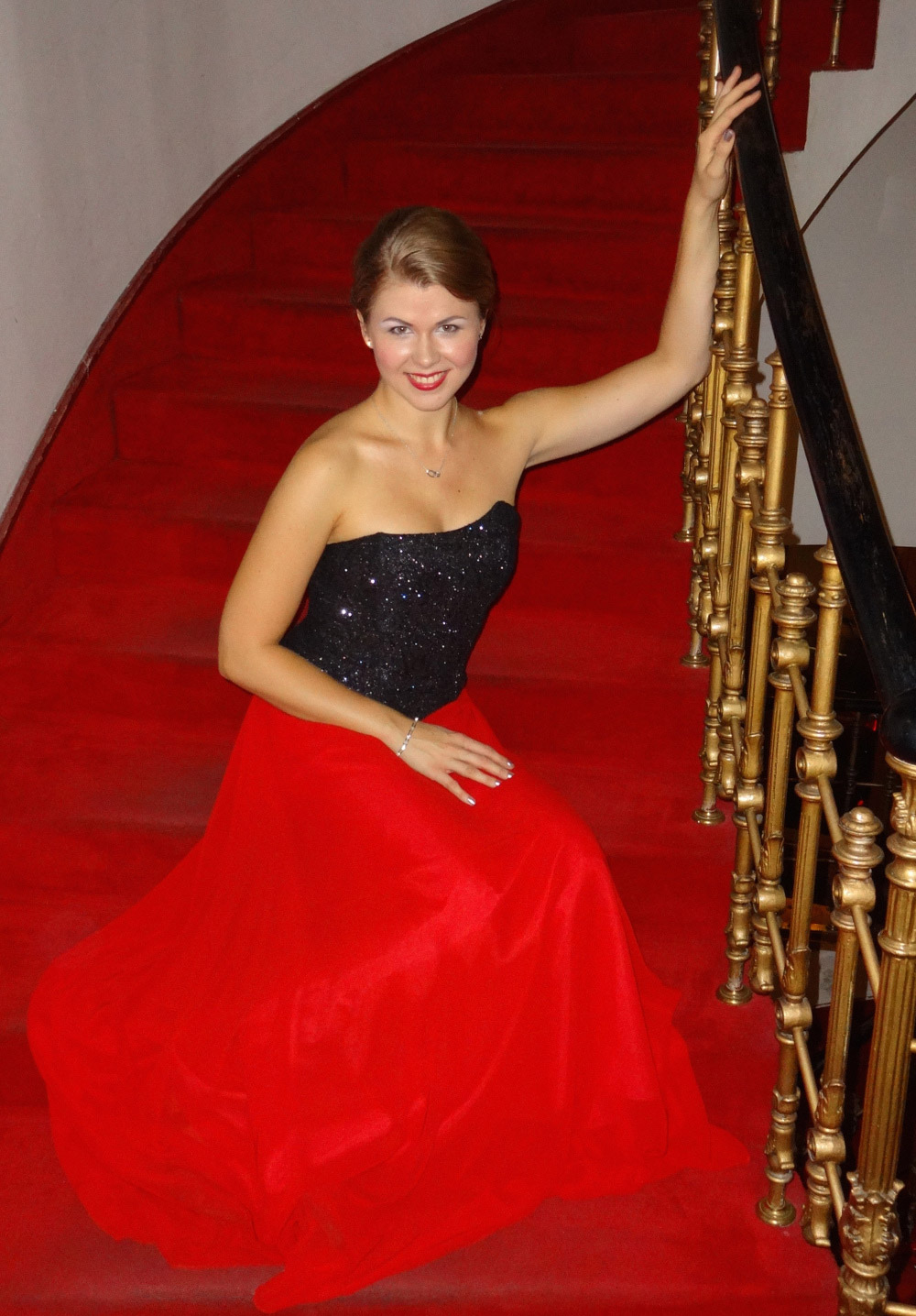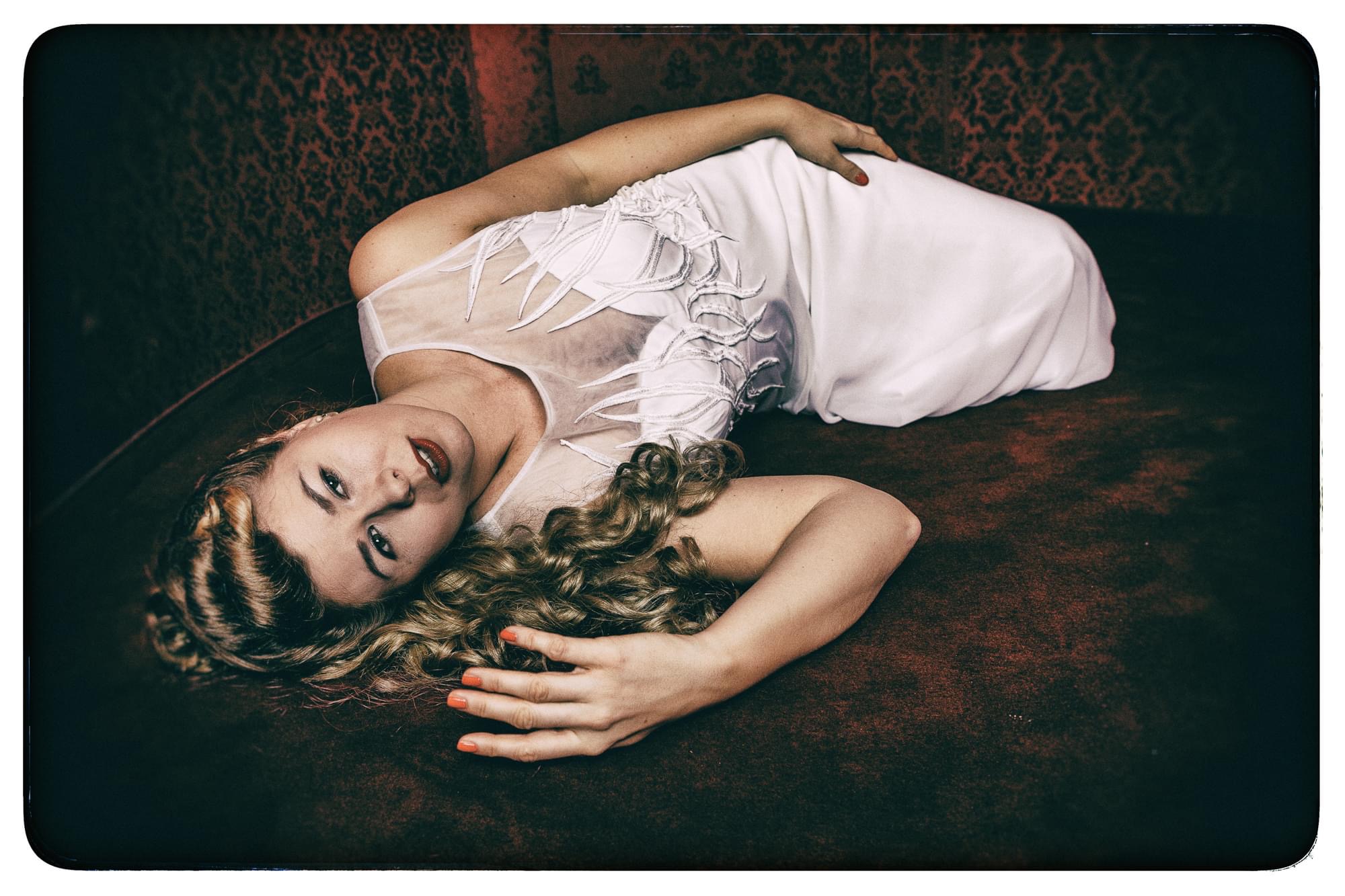
Lucie Kaňková: Rejection and setbacks shaped me, and it takes a lot to knock me down.
The musical journey of soprano Lucie Kaňková has been anything but straightforward. She studied singing in the Swiss cities of Biel and Lucerne, and today she performs on opera stages across the Czech Republic and Europe—appearing in roles such as Donizetti’s Lucia, and Verdi’s Violetta and Gilda. She also embraces the Czech repertoire and, alongside her own singing career, dedicates time to teaching young talents. On October 20, Prague audiences will have the chance to hear her at the Rudolfinum during the opening concert of the *Svátky hudby v Praze* (Holidays of Music in Prague) festival, where she will perform alongside Daniel Matoušek, with Ondřej Vrabec conducting the Prague Philharmonia. How does an operatic persona take shape, and what are her signature roles? These are among the topics explored in the following interview.
„Almost all my teachers during my studies in Switzerland kept telling me: Look for colors.“
„Abroad, the principle is often followed that if a person is not yet capable of performing an entire role, they should not sing individual arias either.“
https://www.klasikaplus.cz/lucie-kankova-formovalo-me-odmitani-a-neuspechy-a-jen-tak-neco-me-nepolozi/
16.10.2026, KlasikaPlus
Transcribtion of the interwiev:
I’ll start our conversation with a somewhat provocative question: your path to singing wasn’t exactly straightforward or clear-cut—in fact, you gave up your studies several times. Yet, you were eventually accepted into an opera studio in Biel, Switzerland. I’m curious about that turning point—that transition when you decided to commit yourself entirely to singing. Could you describe it?
Actually, things happened a bit differently. When I was just ten years old, I took entrance exams for the Jan Neruda Music High School—for both violin and voice. It was decided then that I showed more talent for the violin, so I continued studying voice with Mrs. Bělohlávková only within the framework of a basic art school. Over the next twelve years, people—my husband included—mostly tried to discourage me. In fact, after one concert I gave for the Swiss diplomatic corps, my husband even suggested that I stick to the violin. Competitions usually ended in disappointment for me, but Mrs. Bělohlávková always managed to restore my hope, and we kept working together.
There was, however, one real turning point—a moment when I decided to give up singing for good. I was at a competition for music schools in Prague, singing the first aria of the Queen of the Night. I told myself that since I had managed to pull off something so demanding, I was bound to win at least some kind of prize. In the end, I received absolutely nothing. I was twenty-two by then, and I’d simply had enough. But less than a week later, I suddenly got a call from Switzerland. On the other end of the line was Mathias Behrens, an opera director and the head of the opera studio in Biel, who informed me that he had decided to accept me. I later learned from my professor, Barbara Locher, that the entire expert jury had opposed my admission to the master’s program. Apparently, the director took a stand, asked Barbara if she could teach me, and when she nodded, he accepted me—essentially as his own personal experiment.
I can imagine that starting out in such a position at the school wasn’t exactly an advantage…
It was quite challenging at first, surrounded by older and more experienced classmates. However, two years later, I graduated after performing the lead role of Teofane in Handel’s opera *Ottone* at the local theater—earning the highest possible marks. A year later, I won the opera category at a competition in Karlovy Vary and developed my own project—Bohuslav Martinů’s opera *Ariane*—which eventually took me all the way to the Deutsche Oper am Rhein.
You come from a musical family, and as you mentioned, you’ve played the violin since childhood. Was a career in music—in one form or another—always your clear choice, or did you have a non-musical “Plan B”?
I don’t think the idea of leaving the world of music ever crossed my mind. That said, I did pursue other interests as well. At eighteen, I co-founded Visage Studio and worked for Mary Kay. At nineteen, I started my own small dance school for adults, where I taught ballroom and Latin American dances. I have always enjoyed physical activity—at one point, I even considered becoming a ski instructor—but these were mostly just hobbies.
To sum it up, however, I cannot imagine life without music. Yet, alongside performing, I have always found teaching rewarding as well. Lately, it brings me even greater joy to see my students succeed in competitions, gain admission to top universities, or simply strengthen the vocal technique they need for their flourishing careers.
Could you describe the fundamental differences between music education in Prague and in Switzerland? I’m deliberately not asking about specific schools, institutions, or curricula; rather, I’m interested in the broader approach to music education in both places.
In the Czech Republic, I studied the violin, whereas in Switzerland, I studied singing. The world of instrumentalists and the world of singers are, after all, quite distinct. However, I now have students who have been admitted to institutions like HAMU [the Music and Dance Faculty of the Academy of Performing Arts in Prague], so I have a better insight into that system. I actually completed my own doctoral studies at HAMU, though that focused more on theoretical research.
Perhaps the biggest difference lies in the volume of repertoire and the approach to acting. In Switzerland, I was once told that, by the following week, I was expected to know the entire role of Norina from Donizetti’s *Don Pasquale*—reading from the score, of course. And this was considered completely normal. In our acting training, we worked extensively with our emotions. We had many sessions dedicated to movement, improvisation, and the expression of feelings—no rehearsed operatic gestures, just a natural form of expression that came from within us. We had to understand every single word and be able to express ourselves through the role. I remember one afternoon spent entirely on exploring the various ways one could die. (smiles) Furthermore, instruction took place in four languages, and we were told that we were expected to be fluent in German within a year. So, there certainly wasn’t any time to waste.
Later, at HAMU, you completed your doctorate with a thesis titled “The Romantic Operatic Heroine Violetta Valéry in the Works of Giuseppe Verdi.” This character is quite well-known and popular. What do you think people don’t know about her—but should? Please share some of your insights with our readers…
That is a topic for a much longer conversation. Simply gaining some understanding of the real woman who lived in 19th-century France—and who served as the prototype for this character—can help a performer embody and interpret Verdi’s heroine with greater authenticity. Just knowing the basic facts of her life story is revealing: she was abused by her own father, who even sold her to neighbors, and eventually sold her off to Paris entirely. From a village girl, she transformed into an icon of Parisian society. She changed her name, adopted an elegant French accent, furthered her education, and set the fashion trends in Paris. Yet, she died very young and completely alone.
Even in this brief summary, one can grasp the fate of the woman with whom Alexandre Dumas *fils* fell in love. Sadly, after they parted ways, he did not find her alive again; however, he wrote a beautiful novel and a play about her—a work that captivated Verdi. Because of this, I find myself thoroughly enjoying every performance of *La Traviata*. So far, I have encountered this opera in five different productions across four countries, with more already on the horizon.
After such an in-depth theoretical study, is it still possible to simply let oneself be carried away by the character while on stage?
Absolutely. On the contrary, I am able to feel it much more deeply. After my first performance of *La Traviata*, I was ill for two weeks. I identified so strongly with the character and her tuberculosis that I actually ended up bedridden, doing nothing but coughing. That was when I learned that we must leave a role behind the moment we step off the stage.
Your other essential character is Lucia di Lammermoor. This is a trial by fire of sorts for a coloratura soprano. What is more difficult for you about Lucia – the vocal technique itself, or the psychological arc of the character?
I like psychological arcs. A person can express different emotions, but also use different resonances, expressive elements, work with the voice in many ways. I remember that almost all the pedagogues repeated to me during my studies in Switzerland: Look for colors. I don’t like monotonous characters. Paradoxically, even with the Queen of the Night, who does not spend much time on stage, absolutely everything appears – from recitative to lyrical part to dramatic coloratura. Lucia and Violetta have a similar situation, only their transformations spread over a significantly larger area, and the experience is all the greater.
So far, I had the greatest vocal and psychological experience with Anna Bolena, whom I played at the National Theater in Košice. Maybe soon I will appear with her on another foreign stage, but I am not allowed to talk about it publicly yet. In any case, for me it is not a trial by fire, but rather an opportunity for even greater joy from beautiful music.
In the upcoming season, you will be playing the role of Barča in Smetana’s Hubicka at the Belgian Opéra Royal de Wallonie-Liège. Do you think that the Belgian audience can appreciate and understand Smetana’s opera work?
I already feel at home in Liège, Belgium, and I took part in the production of Rusalka from the Czech repertoire there. It was then that the management of the theater fell in love with Czech music and recently staged several of Janáček’s operas. I recommended Hubička because I was singing it in Ostrava at the time. I even sent the management a recording of our premiere. So, as you can see, Czech authors continue to enchant them. I am looking forward to many familiar faces and another beautiful opera production.
Another commitment for which you don’t have to worry about being accepted is Verdi’s Gilda in Sofia. Will this also be your role debut? And how do you want to approach it so that it doesn’t sound the same for thousands of times?
I’ve sung Gilda in three productions so far, and all of them were accompanied by caroms. I studied it in Opava and when the premiere night came, the iron curtain got stuck, and in the end we only sang selected parts from the front box. This resulted in a nice recording of the aria Caro nome, which I believe is still on YouTube, and which helped me get on the boards of the Royal Opera House in Liège.
I originally came there during the covid to alternate between Donna Anna and Philine. However, in the very first week of my stay, the Gilda representative had a positive test, so conductor Daniel Oren called me. I took the sheet music in my hand and he just said – will you sing on stage with the sheet music? That was our entire conversation, I closed the notes and just sang. He sat about two meters away from me and conducted my scenes from start to finish. Only once did he stop me and ask if I could sing the high E3 in the aria softly and hold it a little. Then he went to the management who just informed me that tomorrow I will sing. No exam. Since then, I often like to return to Belgium, but I still keep it a secret that it was my very first performance of Rigoletto in my life.
The third Gilda was waiting for me at the State Opera in Prague. I was just rehearsing The Magic Flute in Budapest for a tour of Japan when I got a call from Prague asking if I could fly in the very next day. The conductor arrived only fifteen minutes before the start due to a plane delay. I only met the tenor on stage and after the duet, during which the audience applauded us, he hugged me and said: Nice to meet you. In short, it was a real adrenaline rush. So if everything goes well and I return to the stage in Sofia and in this role, I’m already curious about what awaits me.
This September, together with your father, Michal Kaňka, you founded a new music festival called “Classical Music at Slapy” (*Klasická hudba na Slapech*), which takes place in a Baroque church designed by Jan Blažej Santini. Tell us about this project…
It is still in its very early stages. My parents bought a house nearby, and their fascination with this church led them to the idea of establishing a chamber music festival there. This year’s inaugural edition was a great success, and the atmosphere was truly delightful. I therefore hope that, by next autumn at the latest, we will be able to organize a small series of chamber concerts and successfully establish this as a lasting tradition.
On October 20th, you will perform alongside Daniel Matoušek at the opening concert of the “Festivals of Music” (*Svátky hudby*) series in Prague. What kind of program have you prepared? And is there any particular aria or duet that holds a special personal significance for you?
We will perform several excerpts from *La Traviata*—an opera with which I have a very personal connection—as well as Juliette’s waltz aria. I wanted to sing that piece back when I was studying in Switzerland, but I was discouraged from doing so at the time. Abroad, there is often a principle that if one is not yet ready to perform an entire role, one shouldn’t sing individual arias from it either. So, I waited until I had matured enough to handle its exceptionally demanding dramatic finale; now, I can sing it anywhere with joy and a clear conscience. Most of all, however, I am looking forward to the duet from *La bohème* with Dan—it will be my very first time performing it.
You have established yourself as both an opera singer and a concert artist. How do the emotions differ when a young soprano steps onto an opera stage versus a concert stage?
I love the opera stage. In the span of a few hours, one can craft an entire character—complete with psychological and vocal development—and immerse oneself in both the story and the music that permeates it. For me, concerts are like a visit to a spa. I see them as joyful evenings where I can usually sing whatever I feel like, enjoying a variety of musical styles and personas. I also appreciate the freedom to act; I can interpret pieces according to my current state of mind. This is especially true for opera and operetta galas. Sacred music, however, is something else entirely—there, what I enjoy most is its spiritual dimension.
Do you have any role models among musicians who are still active today?
My greatest role model has always been my father, Michal Kaňka—specifically his humility, even though he was one of the world’s top soloists. Among singers, I don’t have one single, definitive role model. When I want to listen to various interpretations of pieces I’m currently learning, I usually look for a performer who resonates with me most in that specific role. However, it has often happened that the same performer didn’t impress me at all in a different role. So, rather than having one overarching vocal role model, it’s more about finding an inspiring artist for a specific piece or role.
To wrap up our conversation, I’d like to go back to the very beginning: in a sense, your career began in spite of people who told you that you didn’t have the voice for singing. If you were to meet that young Lucie—the one who heard those things back then—what would you say to her?
I think I would just let her experience it all over again. I wouldn’t change a thing. Rejection and setbacks really shaped me; it takes a lot to knock me down now. Not even a tenor from La Scala, nor Daniel Oren. Nearly twenty years of playing the violin gave me a strong sense of harmony, rhythm, and intonation. That helps me immensely—and not just when I’m learning new roles. Nowadays, I believe there’s no point in starting opera singing much earlier than around the age of twenty. The vocal cords are the organ that takes the longest to develop—their development continues right up until the age of thirty. So, everything happened in its own time. Life constantly reaffirms for me that things are exactly as they are meant to be.
If you could invite any character from opera to join you for a glass of wine, whom would you choose, and what would you talk about?
We’ve talked a lot about Violetta today, so she was the first to come to mind. Given my French, though, our conversation would likely be limited to the weather and shopping! But right now, an endless list of names is running through my head—from composers to the performers themselves, spanning the centuries. I would be particularly fascinated by the pivotal moments in the history of opera—for instance, what inspired Monteverdi to introduce a new emotional dimension to music, or why he chose to intertwine music with drama. I suspect that a single human lifetime wouldn’t be enough to meet everyone I’d love to have a conversation with.